 Migraine Journal
Free Printable Migraine Diary Template (PDF, 3 Pages)
A free printable migraine diary template built so filling it in produces the four numbers a neurologist asks for. Three pages: grid, attack detail, summary.

Download the printable migraine diary (PDF, 3 pages) — free, no email required. Print one copy of page 1 per month, several copies of page 2, and one copy of page 3 before your next appointment.
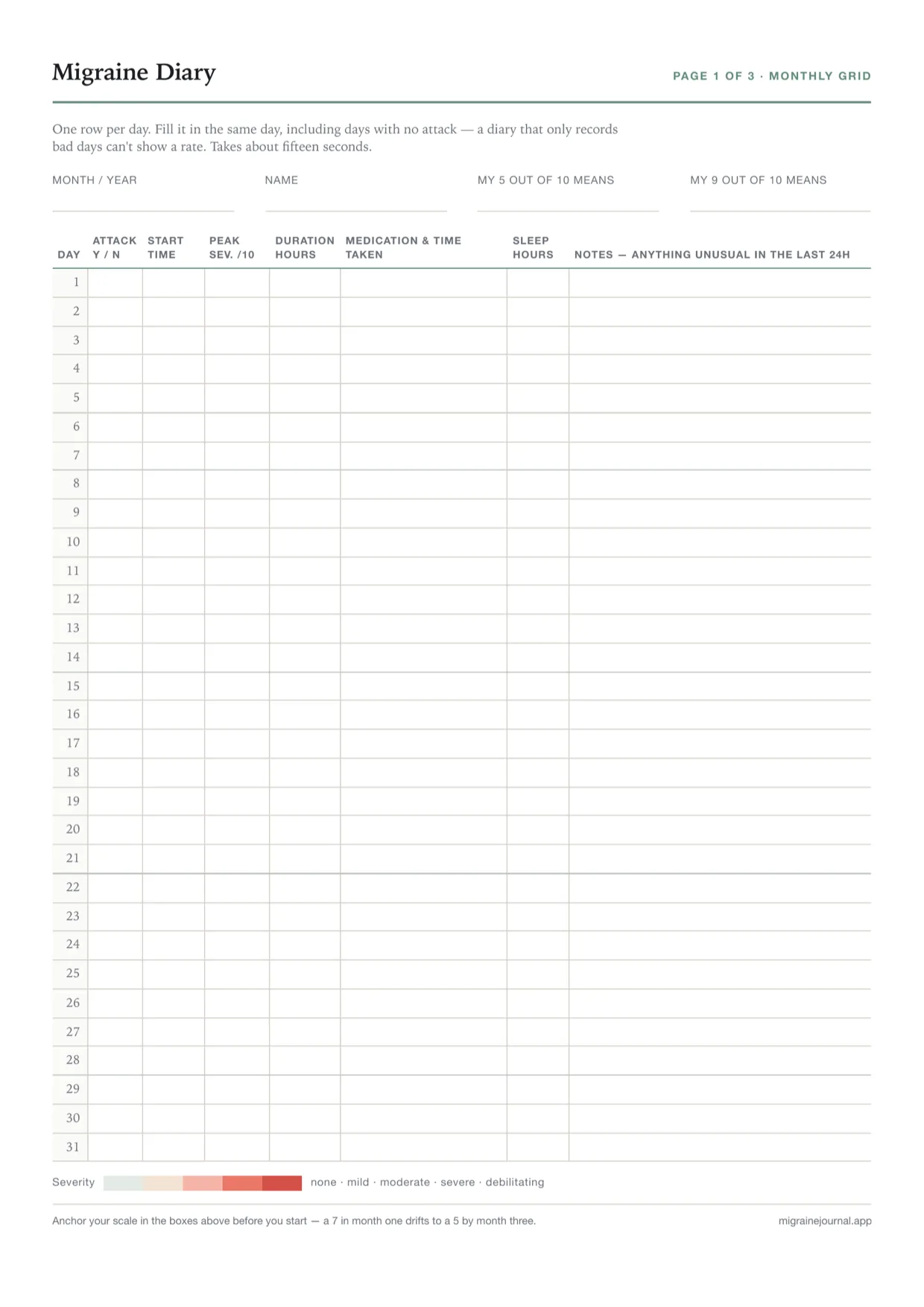
Most printable diaries fail for the same structural reason, so it’s worth explaining what this one does differently before you print it.
Why one-page-per-day diaries get abandoned
The typical template gives each day a full page with room for symptoms, triggers, mood, food, weather, and a notes box.
On a good day you have nothing to write and the page feels absurd. On a bad day you’re lying in the dark and cannot fill in twelve fields. So it gets skipped, then skipped again, and by week three the diary has a gap that makes the whole thing unreadable. The compliance problem is the design problem.
The fix is to split the work by how often it’s needed. A month of days fits on one grid with six narrow columns, taking about fifteen seconds a day. The detailed stuff only gets recorded for attacks, on a separate sheet you fill in once the worst has passed.
What’s on each page
Page 1 — monthly grid. One row per day of the month, ruled for: attack yes/no, start time, peak severity out of 10, duration in hours, medication and the time taken, hours slept the night before, and a short notes column. Non-attack days still get a sleep figure and a tick, because a diary that only records bad days can’t show you a rate.
Page 2 — attack detail sheet. Print a handful. One per significant attack, filled in afterwards. Symptom checkboxes covering aura, nausea, vomiting, light, sound and smell sensitivity, dizziness, fatigue, blurred vision, neck stiffness, tingling and confusion. A head diagram to mark where the pain sat. A trigger checklist grouped into lifestyle, food and drink, environment, and hormonal. A line for what you took, when, and whether it worked. A box for the day after.
Page 3 — appointment summary. Four boxes for the four figures a clinician will ask for: migraine days per month, total headache days per month, acute medication days per month, and a disability score. Those four are counted in a specific way — an attack spanning two dates is two migraine days — and how many migraines a month counts as chronic explains why the distinction changes which side of a threshold you land on. Below that, space for your treatment history: each drug, the highest dose you reached, how long you took it, and why you stopped.
Page 3 is the point of the whole thing. Pages 1 and 2 exist to make it fillable.
How to use it without wasting three months
Fill it in the same day. Memory of pain compresses fast, and by the following morning the start time is gone and the severity has softened. An entry written two days later is a reconstruction, not a record.
Fix your severity scale now. Before you start, write on the top of page 1 what your 5 and your 9 actually mean, in your own words. The common drift is that a 7 in January becomes a 5 by March once you’ve had worse, which makes the trend line meaningless.
Tick the empty days. Ten seconds for sleep hours and “no attack” is what turns the sheet into a rate rather than a list.
Give it three months. The Migraine Trust suggests three months or more before a pattern becomes readable, and shorter runs are where people draw confident wrong conclusions.
Record when things happened, not just that they happened. The trigger you write down may be the attack starting rather than causing it — food cravings, thirst, neck stiffness and light sensitivity are all common in the hours before the pain. How to track migraine triggers covers that trap in detail, and it’s the main reason trigger hunting frustrates people.
Print settings
Print at 100% scale, not “fit to page”, or the ruled rows shrink below writing size. It’s laid out for A4 and prints fine on US Letter with default margins. Black and white is fine; the coral rules are there for structure, not information.
Keep it somewhere you’ll walk past each evening. On the fridge beats in a drawer, and a diary by the bed beats one in another room.
When paper stops being the right tool
Paper is genuinely good for the first three months. It’s fast, there’s nothing to learn, and the friction of a pen is lower than an app during a bad week.
It gets awkward in two places. Adding up migraine days and medication days across three sheets by hand is tedious and error-prone, and it’s the calculation that matters most. And barometric pressure is impossible to record retrospectively, so if you suspect weather plays a part, paper can’t help you test it.
Migraine Journal handles both: the pressure change over the preceding 24 hours is captured automatically at the moment you log, and it produces the page-3 summary as a PDF with an attack calendar and your migraine days normalised per month.
If you’re heading to an appointment soon, what to bring to a neurologist appointment explains what to do with page 3 once it’s filled in, and what to leave at home, while how to share your migraine diary with your doctor covers sending it ahead rather than carrying it in. If you decide paper isn’t going to survive a bad week, the four questions that decide whether an app lasts to month three are the ones worth asking before you install anything. All six printables — the diary, the prep sheet, the trigger tracker and the rest — are collected at free downloads. A diary is a record rather than a diagnosis, so anything it seems to be telling you belongs in a conversation with your GP or neurologist.
Quick answers
What should a printable migraine diary include?
Three separate pages doing three jobs: a monthly grid of one row per day, an attack-detail sheet filled in only after an attack, and an appointment summary holding migraine days, total headache days, acute medication days and a disability score.
Why do one-page-per-day migraine diaries get abandoned?
Because the compliance problem is the design problem. On a good day you have nothing to write and the page feels absurd; on a bad day you're in the dark and can't fill in twelve fields. By week three the gaps make the whole record unreadable.
Should you record days without an attack?
Yes — ten seconds for sleep hours and a “no attack” tick. A diary that only records bad days can show you a list but never a rate, and the rate is what treatment decisions are made against.
How long before a paper diary shows a pattern?
Three months or more, per The Migraine Trust's guidance. Shorter runs are where people draw confident wrong conclusions, and the fix is patience rather than more columns.
Or skip the printing
The sheet works on its own, and plenty of people never want anything else. The app records the same fields, plus the barometric-pressure change over the preceding 24 hours, which is the one column nobody can fill in from memory afterwards.
This article is general information, not medical advice. Talk to your GP or neurologist about your own symptoms, medication, and treatment.